A winged dobsonfly resting by a porch light is an adult; the long-bodied creature hiding beneath a stream stone may be its aquatic larva. A dobson fly changes dramatically between those stages, so the two encounters call for very different things to look for.
The adult’s veined wings and prominent jaws make a memorable sight, while the larva’s legs and side filaments tell a story about life in moving water. Observe both from a little distance: even an insect that looks awkward on land can defend itself when handled.
Dobson flies: recognizing the winged adult
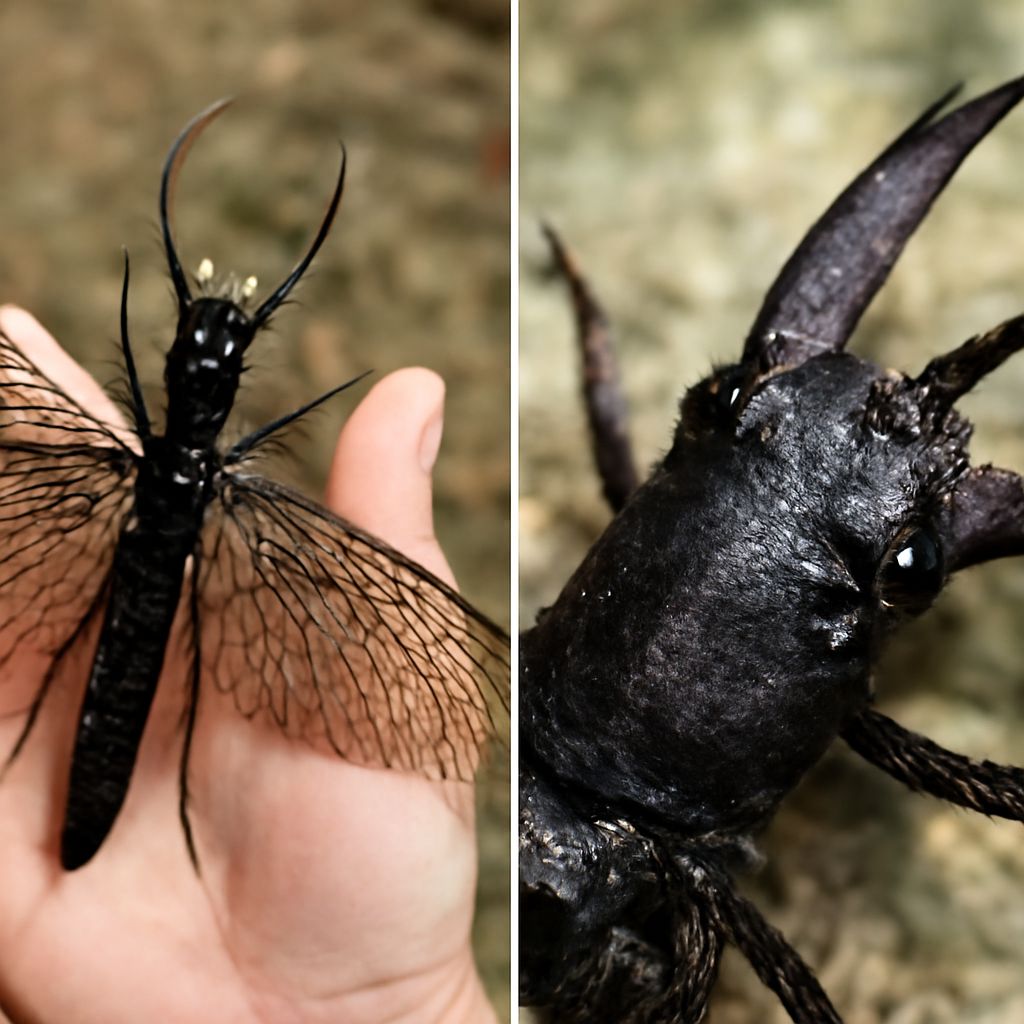
Adult dobsonflies are relatively large insects with two pairs of long, net-veined wings folded over their backs, long antennae, and strong-looking mouthparts. Color and markings vary among species, so a photograph of the whole insect and another of its head are more useful than a single detail viewed in isolation.
For a well-documented example, the eastern dobsonfly, Corydalus cornutus, lives near flowing water in eastern North America. Its adult males and females look strikingly different around the head. A male dobsonfly of this species has exceptionally long, curved mandibles, or jaws. The female’s are much shorter and sturdier. Her jaws can deliver a painful bite and may break skin, according to the University of Florida’s species account.
The long jaws of a male dobson fly play a role in mating. In the eastern species, their size makes them less effective for pinching than the female’s shorter jaws. Leave either sex undisturbed rather than testing the distinction. A dobsonfly male may look as though it is carrying a pair of tiny antlers, but those structures belong to its mouth, not its headgear.
Not every species follows the same proportions. The male of a dobsonfly species can be distinguished from the female only by comparing the features described for that species. Likewise, a male of the dobson fly group need not match an eastern North American field-guide image exactly. Use jaw shape as a clue, then check the wing pattern and location.
Meet the hellgrammite underwater
Larvae of dobson flies are commonly called hellgrammites. Each has a flattened, segmented body, six true legs near the front, a strong pair of jaws, and fleshy filaments along the sides of its abdomen. At the rear, a pair of appendages ends in hooks that help it hold on among stones. Larvae may look like many-legged stream creatures at first glance, but the side filaments are not walking legs.
Hellgrammites are predators. They shelter among rocks and seize other small aquatic animals, including insect larvae. They also form part of the stream food web as prey for fish and other animals. Anglers have long used them as bait, but their ecological role begins well before anyone opens a tackle box.
A Panamanian guide to aquatic invertebrates describes larvae in the family Corydalidae in clear, moderate to fast-flowing streams, often beneath stones. That family-level record gives useful context for observing local waterways; it does not identify a particular individual or establish that the eastern North American species lives in Panama.
From streambed to wings
The life cycle has four stages: egg, larva, pupa, and adult. For the eastern species, females lay egg masses on objects near water. After hatching, the young enter the stream, where they grow and molt. The aquatic stage can last several years, depending on conditions and species; the winged adult is much shorter-lived.
When ready to pupate, a mature larva leaves the water and makes a chamber in soil or other sheltered material near the bank. Inside, it changes into a pupa, then emerges as a winged adult. The contrast is dramatic: the hunter under the stones becomes an insect with broad wings that may turn up at a light after dark.
This timing matters when you observe a stream. A single evening’s visit may reveal an adult, while the longer aquatic chapter remains mostly hidden. The Mississippi State account of the eastern species describes larvae taking one to three years or more to develop. Treat that figure as an example for that species, not a timetable for every tropical relative.
How to watch without disturbing the stream
On a forest trail, pause beside the water and look at vegetation, rocks above the waterline, and nearby lights after dusk. For a useful record, photograph the insect from above and from the side, note the date and general location, and include an object for scale without placing it against the animal. A local naturalist can use those details to narrow an identification.
Avoid lifting stream stones merely for a photograph: they provide shelter for larvae and other small animals. If a stone is moved during an authorized survey, return it carefully to its original position. Keep your fingers clear of jaws, and never pick up an unfamiliar adult or larva to pose it for the camera.
Does an adult by a stream mean larvae are nearby?
It is a reasonable clue, because the young develop in water, but an adult sighting alone cannot locate them. Look for a suitable flowing stream nearby, record what you saw, and let the insect continue its brief winged life without handling it.