A tiny spider turns to face you on a sunny window frame, while another hangs almost motionless in a loose web in the corner. Are they the same kind of spider? Their different body shapes and hunting styles can help you narrow the group, even when the precise species of each spider remains unknown.
Spider species and the clues that narrow a search
Start with what you can observe: the shape of the body, the relative length of the legs, the arrangement of a web, and the place where you found it. A round web suspended between plants suggests a different starting point from a compact spider walking across a wall. Neither clue alone identifies a species, and a web may be empty or occupied by a visitor rather than its builder.
Spider types are often discussed as families, groups that include many related species. Family names can be more useful than a guess at a particular species when you have only one photograph. The examples below describe common patterns, with regional references for comparison; they are not a complete key to the spiders of Panama or a worldwide list.
Orb weavers: the familiar wheel
Many orb weavers in the family Araneidae spin a roughly circular web with spokes and connecting threads. You may notice one between branches or across a garden opening, particularly when moisture makes the silk visible. The spider may sit near the center or wait nearby, responding to movement in the web.
The University of Minnesota Extension guide describes orb weavers as variable in color and size, often with large, rounded abdomens. A wheel-shaped web is a helpful clue to a group, but similar web forms occur outside it, and a damaged or incomplete web may be hard to read. Note both the web and the spider instead of naming the occupant from the silk alone.
Cobweb and cellar spiders: a tangle in a corner
Comb-footed or cobweb spiders, family Theridiidae, often build irregular tangles in sheltered places. Minnesota Extension describes the American house spider as one indoor example: a small brownish or grayish spider that builds a loose web in quiet areas such as basements. A rounded abdomen and a tangled web are useful observations, although neither is exclusive to that family.
Cellar spiders, family Pholcidae, also make irregular webs, but many have especially long, slender legs and small bodies. Penn State Extension describes the longbodied cellar spider in buildings, garages, and other protected places. Its web is a loose mesh rather than a neat wheel. If disturbed, that species may vibrate rapidly in its web, turning a clear view into something resembling a tiny moving blur.
These examples show why location matters: a web in a ceiling corner can suggest families adapted to sheltered spaces. It does not prove that every long-legged spider indoors is the same species. Record the body as well as the web, and compare the observation with a guide for the region.
Jumping spiders: a hunter with big front eyes
Jumping spiders belong to Salticidae. Many are compact, with conspicuous forward-facing eyes and a habit of moving in short, deliberate bursts. Rather than waiting in a prey-catching web, they actively stalk and leap at prey. They still produce silk, including lines and retreats; “no capture web” does not mean “no silk.”
A sunny wall or window can be a good place to watch one from a comfortable distance. Notice whether it turns toward movement, pauses, and then advances. Penn State’s zebra jumper account gives one North American example of a patterned jumping spider, but its description should not be used as a local species list elsewhere. A dark-and-white pattern alone can fit more than one animal.
Wolf spiders and funnel weavers: two ground-level strategies
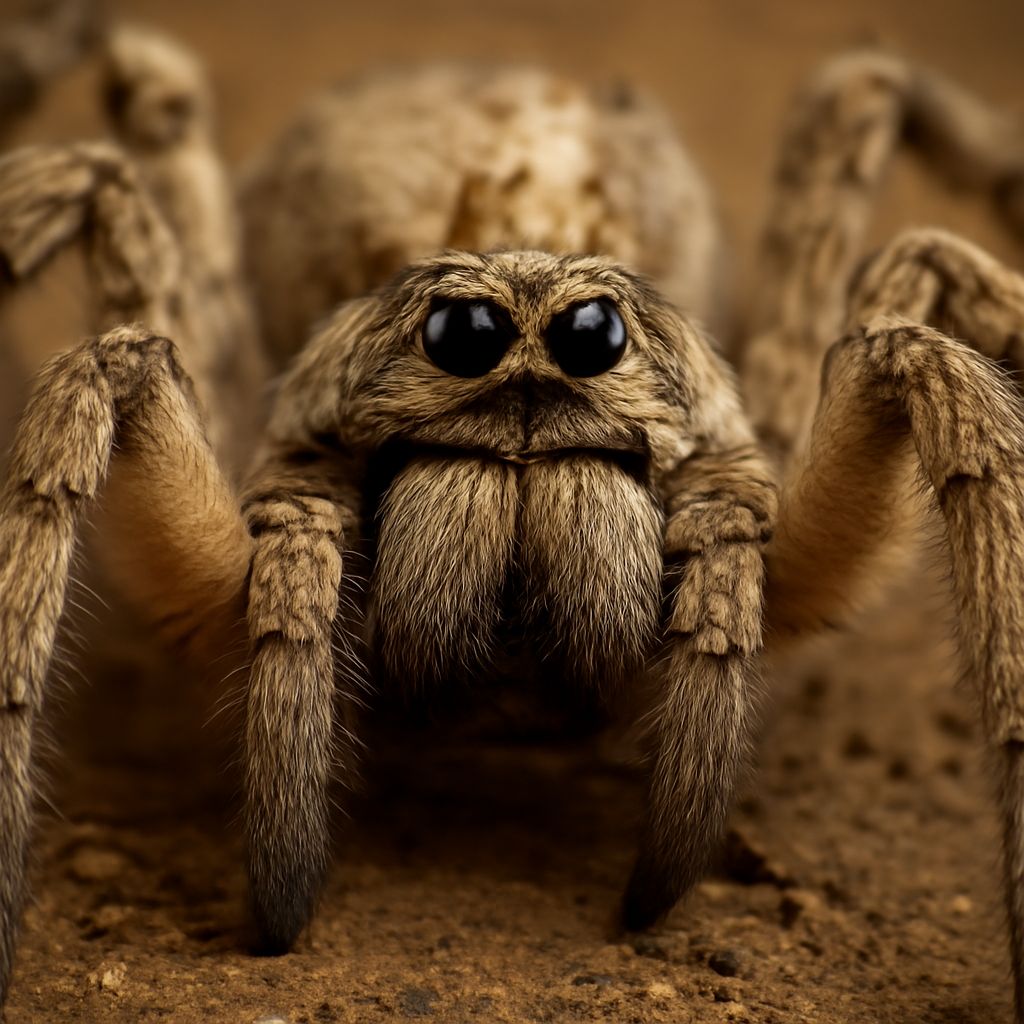
Wolf spiders, family Lycosidae, are active hunters often seen on the ground, among leaf litter, or under cover. They generally pursue prey rather than catching it in a web. Some wander into buildings, so a fast-moving spider on a floor may have come from outdoors. A photograph of the body and, if visible, the eye arrangement can be more informative than speed alone.
Funnel weavers in Agelenidae take another approach. Their sheet-like web has a funnel-shaped retreat where the spider can wait before rushing out toward prey. Minnesota Extension describes such webs in grass, near foundations, and in sheltered building corners. The retreat is part of a capture structure, while a wolf spider encountered away from a web may simply be traveling or hunting.
Among spiders, types that build sheets and types that hunt on foot can occupy similar surroundings. Check for an actual web and observe behavior before choosing a likely family. An absent web in one photograph is only evidence about that moment.
What a broad guide cannot tell you
Not all spiders build the same kind of web, and the types of spider you encounter depend on habitat and geography. Juveniles may look different from adults, males and females can differ, and many unrelated species share colors or markings. A family-level resemblance helps organize a search; distinguishing a spider species may require close examination and expert knowledge.
If you are staying in a mountain lodge or walking a forest trail, leave the animal undisturbed and photograph it from a safe distance. Avoid handling an unknown spider. A local naturalist can compare your images with regional records, including species absent from guides written for another continent.
A quick observation checklist
- Location: Record country, region, habitat, and whether it was indoors or outdoors.
- Body: Estimate body length in inches, excluding legs; note color and markings.
- Legs and eyes: Photograph their arrangement if visible without disturbing the animal.
- Web: Record wheel, tangle, sheet and funnel, or no web observed; include its setting.
- Behavior: Note whether it waited, walked, jumped, or ran, and the time of day.
- Evidence: Take clear top and side views when possible, then consult a regional expert if the identification matters.