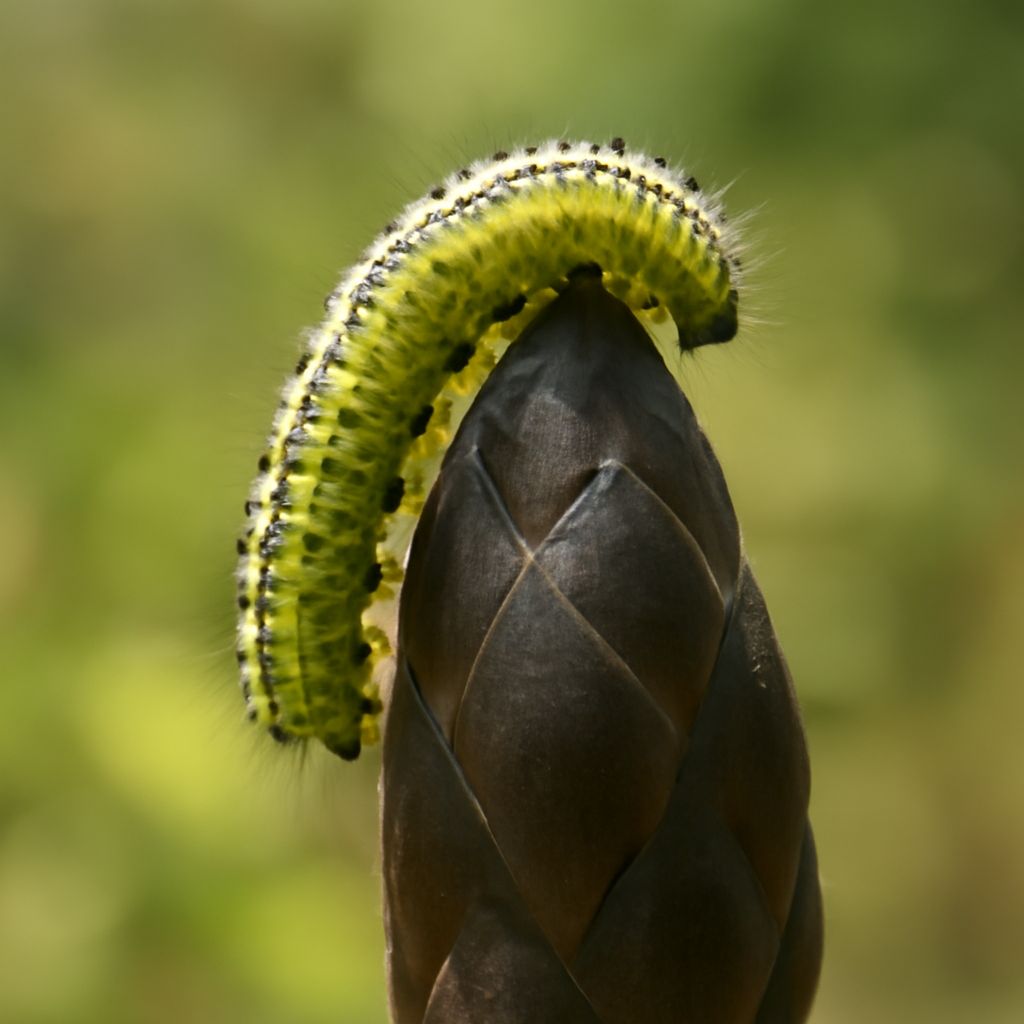
A dark, bristly larva crossing a path and an orange, fuzzy larva feeding on a leaf may belong to different species—or their appearances may reflect different stages of growth. Before you name a black-haired caterpillar or an orange caterpillar covered in fuzz, look at the pattern beneath the hairs, the plant, and where you found it.
Fuzzy orange caterpillar: start with the whole pattern
A fuzzy orange caterpillar can be easy to spot and surprisingly hard to identify. Hairs may be evenly spread or arranged in distinct tufts; the body beneath them may have bands, spots, or contrasting skin between segments. Photograph the animal from above and from the side if you can do so without touching it. Those views can reveal details hidden by a single fluffy silhouette.
A black hairy caterpillar deserves the same careful look. Is it uniformly dark, or are there red gaps between segments? Are the bristles short and dense, or do a few long pencils project beyond the rest? These are starting points for comparison, not a complete identification key. Lighting and the angle of a photo can change the apparent color too.
Banded woolly bear: black ends and a rusty middle
The mature banded woolly bear, Pyrrharctia isabella, usually has stiff black hairs at both ends and a rusty red-brown band across the middle. North Carolina State Extension notes that the orange band widens as the caterpillar grows and molts. A young larva and an older one can therefore present different proportions of black and rust.
This familiar North American example feeds on a variety of low-growing plants. If you see a fuzzy brown caterpillar with dark ends, the arrangement of the bands is more informative than the word “brown” alone. A wide rust-colored middle is also a clue to growth, not a reliable forecast of the coming winter.
Saltmarsh caterpillar: color can vary
The saltmarsh caterpillar, Estigmene acrea, offers another useful comparison. University of Florida IFAS describes larvae ranging from straw or yellowish brown to darker brown, with long hairs especially noticeable in older individuals. It feeds on many plants, including vegetables and weeds such as pigweed, and is recorded throughout the United States, particularly in southern states.
If a brown hairy caterpillar is feeding on a plant, photograph the leaves as well as the insect. A host plant can narrow the possibilities, though this species’ broad menu means one plant name cannot settle the question. A caterpillar crossing bare ground may have wandered away from the plant on which it fed, so describe its location without assuming the nearest plant was its host.
Hickory tussock: pale tufts and dark pencils
Lophocampa caryae, the hickory tussock moth, makes a useful contrast with an evenly dark larva. University of Massachusetts Extension describes white hairs over much of the body, a central line of black hairs, and longer black tufts near each end. The different lengths and arrangement of those hairs matter as much as their colors.
Its documented hosts include hickory, walnut, oak, maple, and several other trees. A photograph showing the caterpillar on a recognizable leaf is stronger evidence than a cropped image of fuzz alone. This is a North American comparison example; its inclusion here does not establish that it occurs on a particular Panamanian trail.
Giant leopard moth: look between the bristles
A furry black caterpillar with stiff bristles and narrow red bands between its body segments could invite comparison with the giant leopard moth, Hypercompe scribonia. The Illinois Department of Natural Resources notes that the red bands can be visible when the larva curls. Its larvae feed on a variety of trees, shrubs, wildflowers, and garden plants.
Do not prompt a caterpillar to curl for a better picture. If it naturally moves into that position, a clear photograph may show the skin between segments. An all-dark view can hide that clue, and other species may share elements of the pattern. Compare your observation with records from the region where it was found before assigning a name.
Use location, age, and plant together
A dark caterpillar with long hairs in Panama should be checked against reliable regional records, rather than assigned a North American name from a similar photograph. Likewise, a brown fuzzy larva may change its markings as it grows. Caterpillars shed their skin through several growth stages, called instars, and the appearance of a young larva can differ from the adult-sized one pictured in a guide.
Photographs are evidence, not always a verdict. A blurred side view may conceal the back; glare can wash out pale bands; a picture of a plant may lack enough detail for identification. If the clues do not agree, leave the identification at a broader group and ask a local naturalist or an identification community to review the images.
Observe without handling. Poison Control notes that some caterpillar hairs or spines can cause painful or itchy reactions. Even a wonderfully fluffy coat is best appreciated with your eyes and camera. Give the animal space to continue its journey; it has enough to do without becoming a tiny photo prop.
What to record
- Place and date: Include the region, habitat, and approximate elevation if known.
- Pattern: Note bands, spots, and the color of skin visible between segments.
- Hairs: Record whether bristles are even, tufted, short, or have long projecting pencils.
- Size and stage: Estimate length in inches and note whether it appears small or nearly full-grown; do not infer age from size alone.
- Plant and behavior: Photograph the whole plant and leaves, and record whether the larva was feeding or merely passing by.
- Views: Take clear top and side photographs without touching or moving the animal.