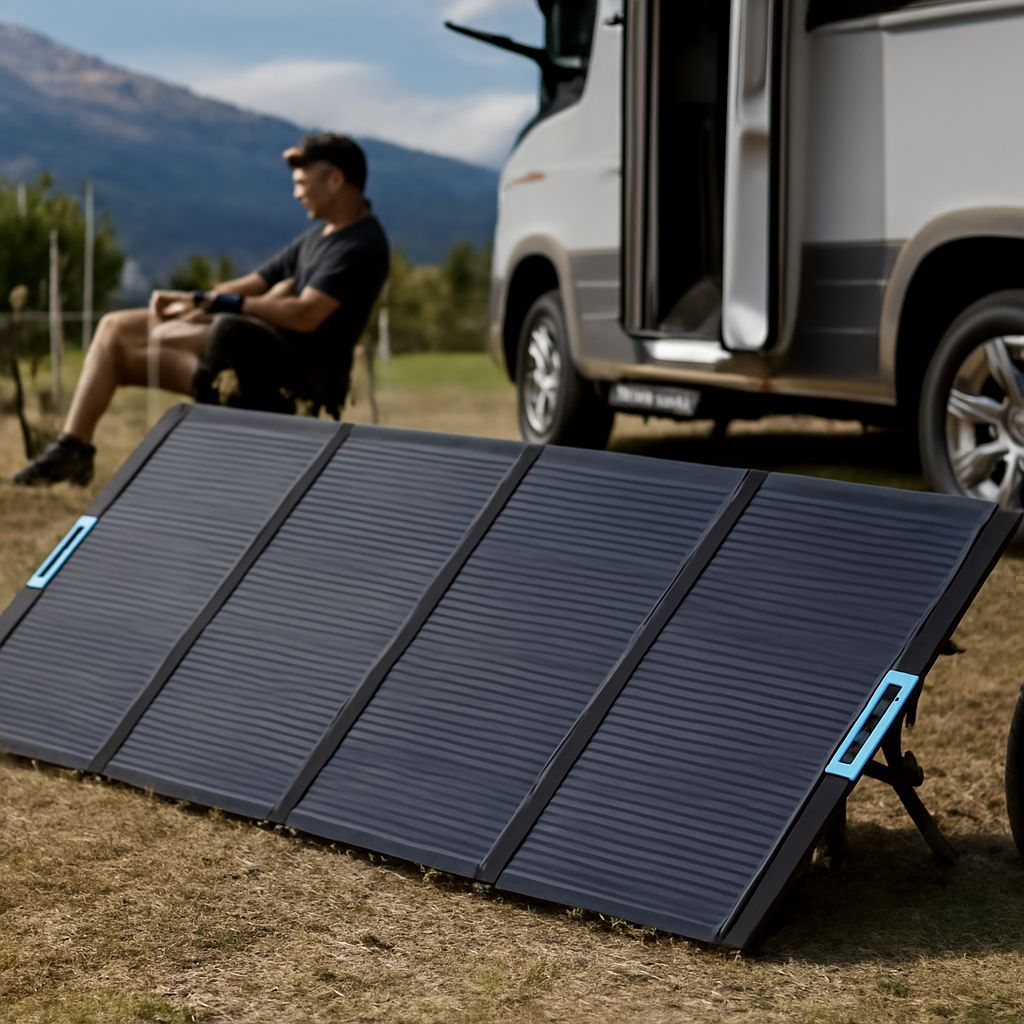
A weekend camper who needs one phone recharge can often leave home with a full power bank. A group charging phones, a camera, and a navigation device for several days may need portable camping panels that turn sunlight into electricity as well as a battery to store it.
The best camping panels that are portable and solar-powered depend on how much energy you use and how long you can leave them in the sun. In Panama’s humid mountains, plan around cloud, shade, and rain as well as the number printed on the panel.
Calculate your daily energy use
List each device and estimate the energy it needs each day in watt-hours (Wh). A battery’s watt-hour rating is often printed on its label or specification sheet. If you know its voltage and capacity in amp-hours, multiply the two: 3.7 volts × 5 amp-hours equals 18.5 Wh. Divide milliamp-hours by 1,000 first to convert them to amp-hours.
For a simple example, suppose a group uses 20 Wh to recharge a phone, 10 Wh for a camera battery, and 5 Wh for a navigation device each day. The devices need 35 Wh per day. Actual use may differ, so measure at home with a USB power meter if possible. Include everyone’s devices and any battery-powered equipment you intend to recharge.
Charging and storage waste some energy as heat. If your entire charging chain is 70% efficient in this example, you need roughly 35 ÷ 0.70 = 50 Wh from the panel each day. The 70% figure is an illustrative allowance, not a measurement of every setup. Different devices, cables, and batteries will produce different losses.
Separate panel watts from battery capacity
Watts (W) describe power at a moment; watt-hours describe energy over time. A panel rated at 25 W does not store 25 Wh. Its rating describes output under standardized test conditions. A power bank or power station stores energy, usually advertised in Wh or milliamp-hours.
If a 25 W panel averaged 15 W for four hours, it would produce about 60 Wh during that period. That is a calculation, not a promise of four useful hours: the sun’s angle, cloud, shade, and heat all affect output. The U.S. Department of Energy explains why actual energy yield differs from performance under laboratory conditions.
Check battery capacity against the time you might go without charging. For the 35 Wh daily example, two cloudy days mean 70 Wh delivered to devices. At an assumed 80% battery-to-device efficiency, you would need about 88 Wh of usable stored energy. A battery’s labeled capacity and its usable output can differ, so leave additional margin and begin the trip fully charged.
Best portable solar panels for camping: Pick a practical size
Small portable solar chargers for camp are easier to carry and may suit a phone or compact power bank when you have regular sunny breaks. They have limited surface area, so replenishing several devices can take time. A larger folding panel can collect more energy when conditions allow, but it takes more space in a pack and needs a larger clear area to deploy.
The best portable solar panels for camping are the ones that can replenish your calculated use during the sunlight you can actually access. Among the best portable camping solar panels, compare output in your conditions with that 50 Wh daily target. If a 25 W model averages only 10 W, it needs about five hours to provide 50 Wh; if weather cuts that window short, draw on your reserve or reduce use.
For portable solar panels, camping under tree cover can mean much less output than a sunny campsite. On a short shaded trip, a charged battery alone may weigh less than a panel and backup battery together. For a longer base camp with a clear spot, the extra collection capacity can be worth carrying.
Check connections before leaving
A USB output can charge a compatible device or power bank directly. Larger panels often use a dedicated connector and may need a compatible charge controller or a power station with a built-in solar input. Do not connect a bare panel directly to a battery unless the equipment instructions specifically permit it.
Check the plug, polarity, panel voltage, and current against the receiving device’s allowed input range. A matching connector alone does not establish electrical compatibility. Check the maximum input wattage too: a station may accept less than the panel’s rated power. Use manufacturer-approved adapters and confirm whether your bank can accept charge while supplying another device if you plan to do both at once.
Test the entire chain at home: panel to battery, then battery to each device. Make sure you have the right cables and that charging resumes after the panel is shaded and returns to sunlight. Some devices interrupt charging when power fluctuates.
Set up for sun and protect the electronics
Place the panel where the whole surface receives direct sun, and angle it toward the sun when practical. A branch shadow across part of it can reduce output; watch for shade moving across your chosen spot. Secure the panel against gusts without stressing its hinges or leads. Keep the battery and phone in a shaded, ventilated place within cable reach, following their operating-temperature limits.
Check the manufacturer’s water-resistance rating for each component. A panel that tolerates splashes does not automatically make its USB ports, cable connections, or battery weatherproof. Keep those parts dry, disconnect before handling wet plugs, and pack the system away when rain exceeds its specified protection. Dry equipment before storage.
With solar power, camping in changeable weather calls for a fallback. A larger charged battery, lower device use, or an opportunity to recharge from an outlet can cover a run of gray days. Choose portable panels for solar charging at camp only after estimating daily Wh and the clear hours available. Pair them with enough stored energy for the cloudy interval you are prepared to handle.