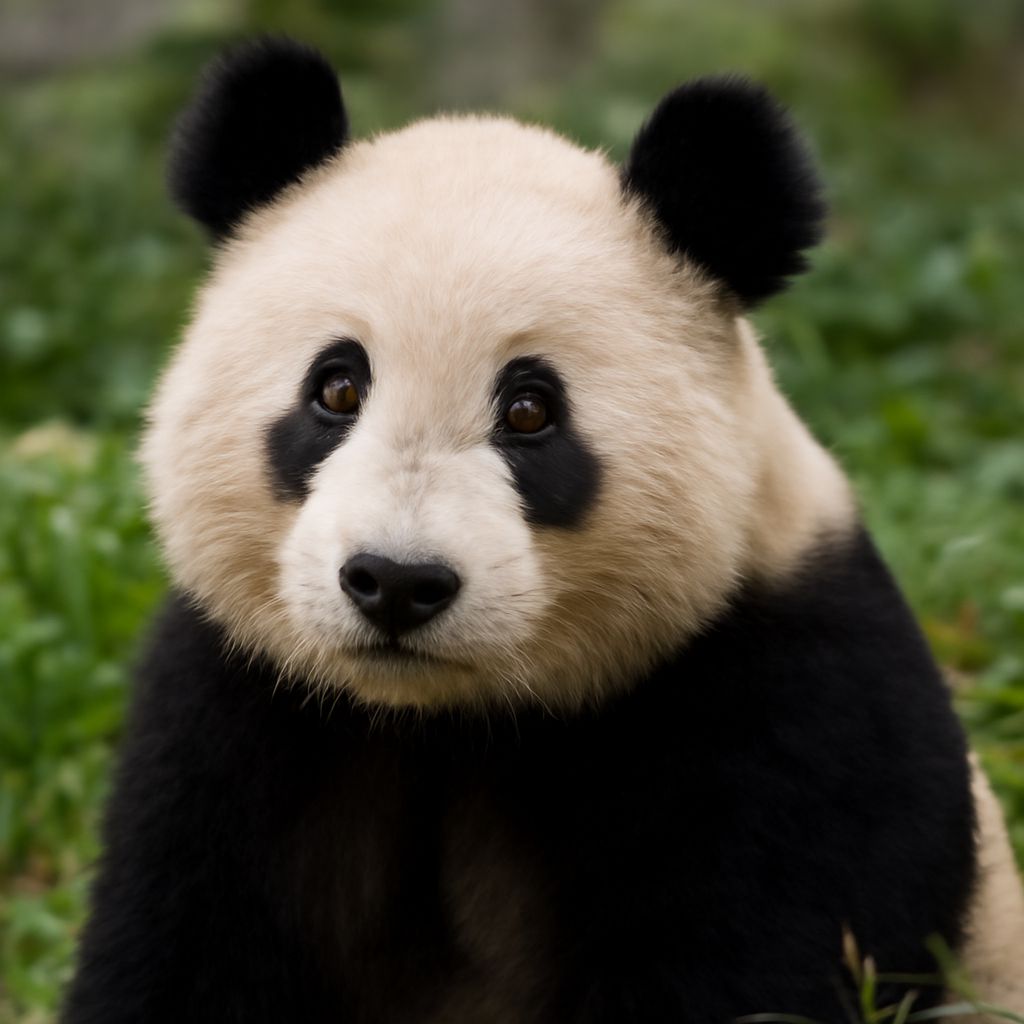
A panda at a zoo lives in a carefully managed enclosure; a wild giant panda needs a much larger landscape of mountain forest and bamboo. Knowing where these bears live in nature also changes how you picture their size: how large can a panda grow when that round face belongs to a full-grown bear?
Mountain forests in central China
Wild giant pandas live in a handful of mountain ranges in south-central China, in Sichuan, Shaanxi, and Gansu provinces. The Smithsonian’s National Zoo describes forests of broadleaf trees and conifers with dense bamboo underneath, generally at elevations of about 5,000 to 10,000 feet. Rain and mist can wrap the slopes in cloud, while the understory provides much of the food the bears need.
Where do panda bears live within that broad region? They occupy scattered patches of suitable forest, not every mountain slope in the three provinces. The Minshan and Qinling ranges are examples of the mountain landscapes associated with them. Their present range is much smaller than their historical range, and farming, forest clearing, and development have helped restrict them to the mountains.
A misty mountain forest may sound familiar to someone planning a walk in Panama, but the resemblance is ecological rather than a sign that the same animals occur there. Wild giant pandas are native to China. A zoo animal elsewhere is living under human care, not in a wild population on that continent.
How big is a panda when fully grown?
According to the Smithsonian, adults typically measure about 4 to 6 feet long and stand 2 to 3 feet at the shoulder on all fours. Males are generally larger than females: wild males can weigh up to about 250 pounds, while females rarely reach 220 pounds. Individuals vary, so these figures describe a useful range rather than the dimensions of every adult.
For a sense of scale, imagine an animal about the size of an American black bear, with a broad head and strong shoulders. Its thick coat adds to the rounded outline, but there is substantial muscle beneath the fur. How big is a panda at birth? The contrast is striking: a newborn generally weighs only 3 to 5 ounces, is blind and helpless, and relies on its mother for warmth and care.
The size of a panda changes dramatically as it grows. A cub’s tiny beginning tells you little about the space, food, and strength of an adult. Mothers care for their young for a long period; the Smithsonian reports that offspring may remain with them for one and a half to three years.
Bears with an unusually specialized menu
Are giant pandas bears? Yes. The giant panda, Ailuropoda melanoleuca, belongs to Ursidae, the bear family. Its strong build, paws, and teeth sit within that family even though its feeding habits are distinctive. Is a panda a bear? The answer is still yes when you see one calmly handling a bamboo stalk instead of the food you might expect another bear to choose.
Their diet is overwhelmingly bamboo. Broad molars and strong jaw muscles help crush fibrous plant material, while a fleshy pad over an enlarged wrist bone acts as a “pseudo-thumb,” helping grip stems. It is a modified wrist structure rather than an extra true thumb. This combination makes a bear’s paw an effective tool for handling a rather uncooperative grass.
Pandas have a digestive system more like that of a carnivore than a specialized plant digester, so much of what they eat passes through as waste. They spend many hours foraging and feeding to obtain enough nourishment. Bamboo is not just scenery around a bear’s home: its availability shapes where the animal can remain and feed.
Why connected habitat matters
Knowing the places where panda bears survive also means understanding the routes between forest patches. Roads and other infrastructure can fragment habitat, separating populations and making it harder to reach food or potential mates. World Wildlife Fund identifies roads, railways, and other development as pressures on habitat connectivity.
That matters when bamboo changes. Some bamboo plants flower together and then die back; pandas need access to other healthy stands when local food becomes scarce. A WWF climate assessment highlights connected habitat as one way to help pandas move as conditions change. A forest corridor is therefore more than a green line on a map: it can link feeding areas and populations that would otherwise be isolated.
Protection also concerns more than one species. Conserving connected mountain forests can benefit other plants and animals that share them, as well as the communities living around those landscapes. The question of where panda bears make their homes leads directly to the quality and continuity of the forest around them.
Daily life among the bamboo
Adult pandas are generally solitary, although they communicate through scent marks and calls and meet during breeding. In dense vegetation, a scent left on a tree or rock can carry information when its maker is out of sight. A female’s scent can also attract males during the breeding season.
Unlike some bears, giant pandas do not hibernate. They alternate feeding with rest and may move between elevations with the seasons. Their young start life dependent on maternal care, so a female needs a secure place to raise a cub as well as access to food. The same forest must supply shelter, bamboo, and room to move through the bear’s changing daily needs.