On a dry Southwestern hillside, you spot a compact evergreen beside a juniper. Is it a piñon, or simply another pine? A piñon tree’s short needles and small cones are useful clues, but you need to consider the species and the region together.
A tree known as a pinyon pine belongs to a group of pines, not to one universal species. These woodlands are characteristic of parts of the southwestern United States and northern Mexico; they are not a field guide to Panama’s mountain forests.
Pinyon pine tree: needles, cones, and a closer look
A pinon tree is usually a relatively small, slow-growing pine with evergreen needles and woody seed cones. Mature individuals often have rounded or irregular crowns, especially in dry, exposed landscapes. Height and silhouette alone are not enough, however: drought, age, and local conditions can reshape a tree.
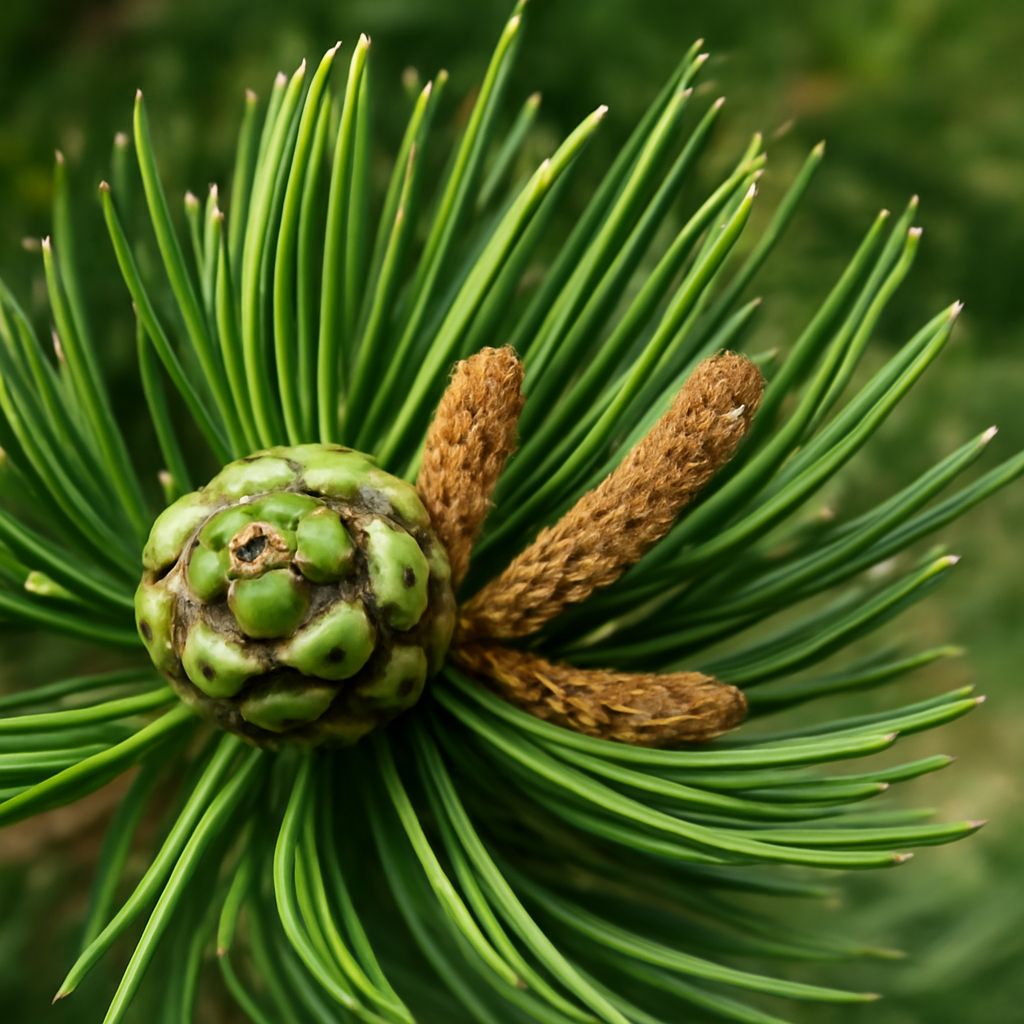
The most helpful detail is often a fascicle, the small bundle where pine needles grow together. Look at several bundles, not one loose needle. The cones and geographic setting supply additional evidence, while bark and overall form help complete the picture.
| Species | Needle clue | Regional context |
|---|---|---|
| Colorado or two-needle piñon, Pinus edulis | Usually two needles per bundle | Widespread on the Colorado Plateau and elsewhere in the Southwest |
| Singleleaf piñon, Pinus monophylla | Usually one needle per bundle | Especially associated with the Great Basin and neighboring areas |
| Mexican piñon, Pinus cembroides | Usually three needles, sometimes two or four | Parts of the Southwest and Mexico |
The National Park Service overview describes these and other piñons in regional woodlands. Utah State’s guides show two-needle piñon and singleleaf piñon for comparison. A single needle count is not a complete key: hybrids and variation can complicate identification where ranges meet.
Needles are not the whole tree
The needles of P. edulis are fairly stiff and roughly 1 to 2 inches long. Singleleaf needles grow singly rather than in the obvious pairs of its better-known relative. New growth, damaged shoots, and viewing angle can confuse a quick count, so compare multiple shoots with an illustrated local guide. You do not need to strip a branch to inspect it.
A pinyon tree produces separate pollen-bearing and seed-bearing cones. The seed cones develop over more than one growing season; as they mature, their scales open and release seeds. A young green cone and an older brown one can look quite different on the same walk. The Forest Service account of singleleaf piñon explains its cone development and regional distribution.
A cone under a tree is a clue, not proof that it fell from the branch directly above. Wind, water, and animals can move plant material. If you can see attached cones as well as the needles, record both; otherwise leave the identification tentative.
Piñon or juniper?
Piñon-juniper woodland brings different kinds of trees together. A pine has needles and woody cones, while many local junipers have small, scale-like leaves on mature growth and fleshy, berry-like cones. The two can share a rounded outline from a distance, making a closer look at foliage more useful than guessing from silhouette.
In the Colorado Plateau, for example, Pinus edulis may grow with one-seed juniper, Juniperus monosperma. The National Park Service’s Bandelier woodland guide shows this association. It is a relationship between different trees, not evidence that a juniper is a kind of pine.
These woodlands vary in density and composition. Some are relatively open, with grasses and shrubs between trees; others have more continuous canopy. A piñon pine tree’s companions depend on local elevation, soil, climate, disturbance, and history, not a fixed planting plan.
Seeds, wildlife, and people
Many piñons produce substantial seeds commonly called pine nuts. Pinyon pine trees provide food and shelter for wildlife across these woodlands. Birds and mammals feed on them; pinyon jays also transport and cache seeds, and some uneaten caches can grow into new trees. Cone crops vary, so a tree without visible seeds in one season is not necessarily unhealthy or misidentified. A piñon tree’s harvest can differ considerably from year to year.
Piñon seeds have long been important foods for Indigenous peoples of the region, with knowledge and practices rooted in particular communities and places. Utah State University discusses documented Indigenous uses of Utah forest trees. That history deserves more than treating every cone as a free snack: access rules, land management, community practices, and wildlife needs matter.
Do not eat an unidentified seed or assume that a pine-looking cone gives permission to collect it. If gathering is allowed and appropriate, seek current site rules and knowledgeable local guidance first. The different species of pinyon pines have different ranges and features, and not every pine is a piñon.
Read the landscape before naming the pine
Pinon trees are associated with dry woodlands of western North America, but the exact mix changes across the Southwest. P. edulis is especially familiar on the Colorado Plateau; P. monophylla is prominent in the Great Basin. Their ranges can meet, and hybrids can make a neat one-versus-two rule less certain. The Forest Service’s singleleaf species review discusses that overlap.
Elsewhere, including the mountains of Panama, start with a guide to plants actually documented in that region. A compact evergreen with cones may belong to a different group altogether. A pinyon pine tree in a photograph cannot be placed in a local flora without evidence of the location and identification.
For a field note, record the region and habitat first, then compare several needle bundles, attached cones, bark, and neighboring vegetation. Photograph the tree and its details without damaging it, and consult a regional botanist or field guide when the clues disagree. A patient comparison is more reliable than a label based on one small cone.