A long, twisted pod beneath a tree and a short, flat pod beneath another may both belong to plants called locusts, but they are not interchangeable. The seed pods of a honey locust are often much longer than those of black locust; look at the whole tree before deciding which you have found.
Pods on locust trees are useful starting points, especially when they remain on branches or scatter across a path. Leaves, thorns, location, and season add context. None of these clues makes an unfamiliar pod safe to taste, and a tropical tree with a similar fruit may be a different species altogether.
Locust tree pods: start with length and shape
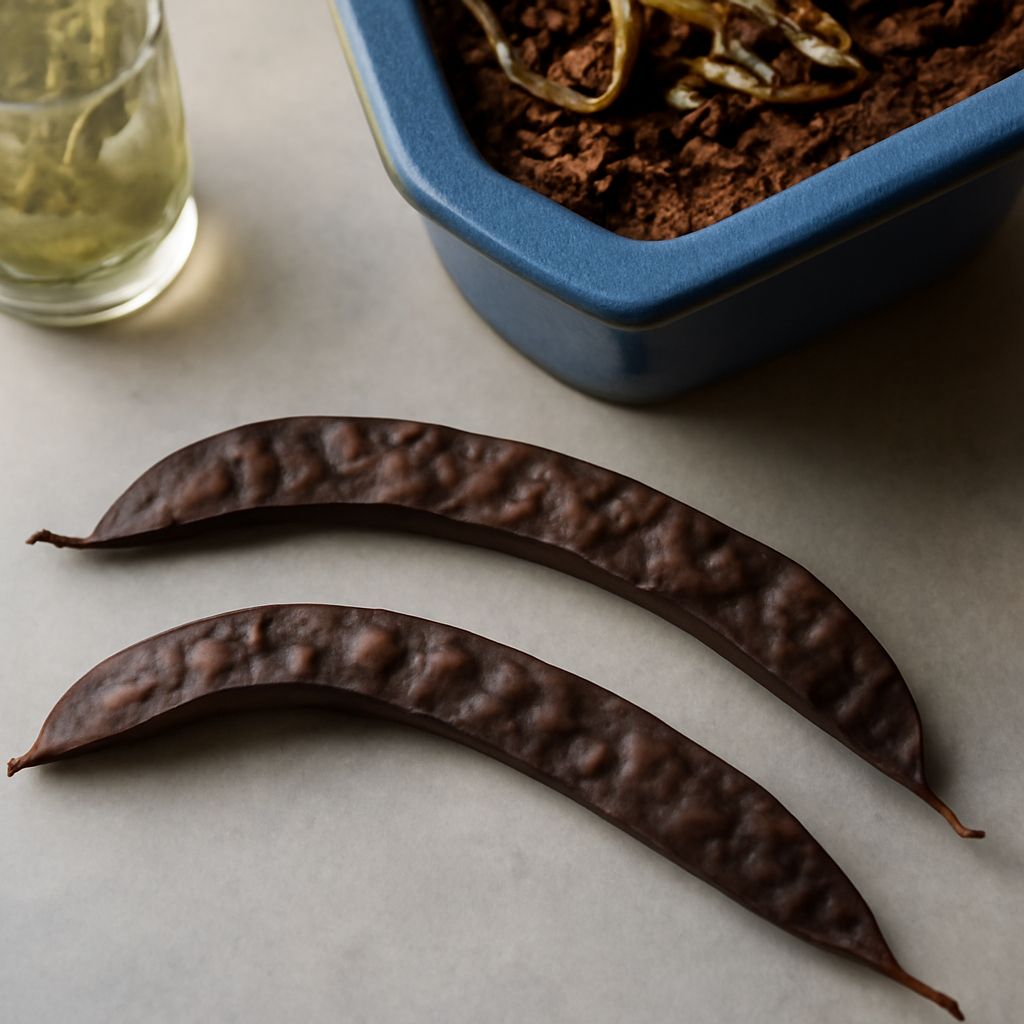
Honey locust, Gleditsia triacanthos, is a North American tree in the legume family. Its ripe fruit is a flattened, leathery pod, often curved or twisted like a dark ribbon. The Minnesota Department of Natural Resources describes pods typically about 10 to 18 inches long, with hard seeds separated by pale pulp.
Those honey locust seed pods may begin green and darken to brown or nearly black as they mature. The pod is the fruit; the hard objects inside are its seeds. Not every tree produces an obvious crop every year, and some planted selections bear few or no pods, so an empty patch of ground tells only part of the story.
By contrast, the black locust, Robinia pseudoacacia, usually bears shorter, flatter pods. University of Minnesota Extension gives a typical length of 2 to 4 inches. Both are legumes, but they are separate species in different genera. A flat fruit is family resemblance, not a positive identification.
What the seeds and pulp do
Honey locust tree seed pods contain several flattened, hard seeds embedded in sweet, sticky pulp. The pulp helps attract animals that feed on the fruit; some seeds can pass through an animal and be deposited elsewhere. This is one way fruit and seed structure connect a stationary tree to movement across a landscape.
The U.S. Forest Service account documents honey locust pods as food for livestock and wildlife. Animals eating a known plant does not establish that an unidentified pod is safe for people or for every animal. Nor does a pod’s sweetness prove that it came from this species. There is no need to open or sample a mystery fruit to begin an identification.
Honey locust tree pods have also been used in livestock feeding, and Feedipedia describes documented uses of the pulp, including fermentation for beverages. Those uses refer to an identified species and particular practices; they are not a recommendation to prepare a pod collected beside a trail. Black locust bark, leaves, and seeds contain toxic substances, according to Cornell’s guide to poisonous pasture trees.
Look up from the pod
A fruit found on the ground may have rolled or been carried away from its parent. Before comparing locust tree seed pods with a field guide, check whether matching fruit remains attached overhead. Take care around branches and avoid standing beneath anything unstable. A picture of the pod beside a ruler, taken without handling it, can help communicate its size.
Then look at the following features together:
- Leaves: Honey locust leaves are compound, with many small leaflets. Some are divided twice, so a leaf can look especially fine and feathery. Black locust has compound leaves with larger, rounded leaflets.
- Thorns: Wild honey locust commonly has long, often branched thorns on the trunk or larger branches. Black locust typically has short paired spines near leaf bases. Observe from a distance: the larger thorns are sharp.
- Flowers: Black locust bears showy hanging clusters of white, pea-like flowers. Honey locust flowers are smaller and less conspicuous. Flowers may be absent when you find ripe pods.
- The setting: A planted street tree, a woodland edge, and a tropical trail may present different possibilities. Location helps select a guide; it does not identify the tree by itself.
Thornless honey locust selections are common in landscaping, so the absence of thorns does not rule the species out. A cultivated tree may also lack conspicuous fruit. Look for several supporting characteristics rather than insisting that every individual match a single photograph.
Similar fruit, different tree
Other legumes can carry long, flat, or curved pods, and species vary from one region to another. Water locust, Gleditsia aquatica, is a North American relative with smaller pods, while black locust has the shorter fruits and paired spines described above. A long pod photographed in Panama might belong to another member of the legume family entirely; do not import a North American identification simply because the shape looks familiar.
For a tree near Santa Fe or elsewhere in Veraguas, note the habitat and ask a local botanist, guide, or park staff member about regional possibilities. Photographs of leaves, bark, the whole crown, attached fruit, and any flowers are more useful together than a close-up of a single seed. If a feature is hidden, record that rather than guessing.
The pods and seeds of a honey locust tell a story about reproduction and wildlife, but only when the species is identified correctly. Measure what you can see, compare leaves and thorns without touching them, and consult a regional reference or specialist. Leave an unknown pod uneaten, however persuasive its resemblance to a familiar bean.