A large striped beetle lands beside your porch light, and before you move it, you wonder whether a ten-lined June beetle can bite. Its pale stripes may look almost black and white in the evening light, but a closer look at the whole insect and where you found it will tell you more than color alone.
Give the visitor a little space while you look. Its sudden hiss can be surprising, especially when the insect seems to have brought its own tiny sound effects, but sound by itself is not a species identification.
Black and white striped beetle: look beyond the pattern
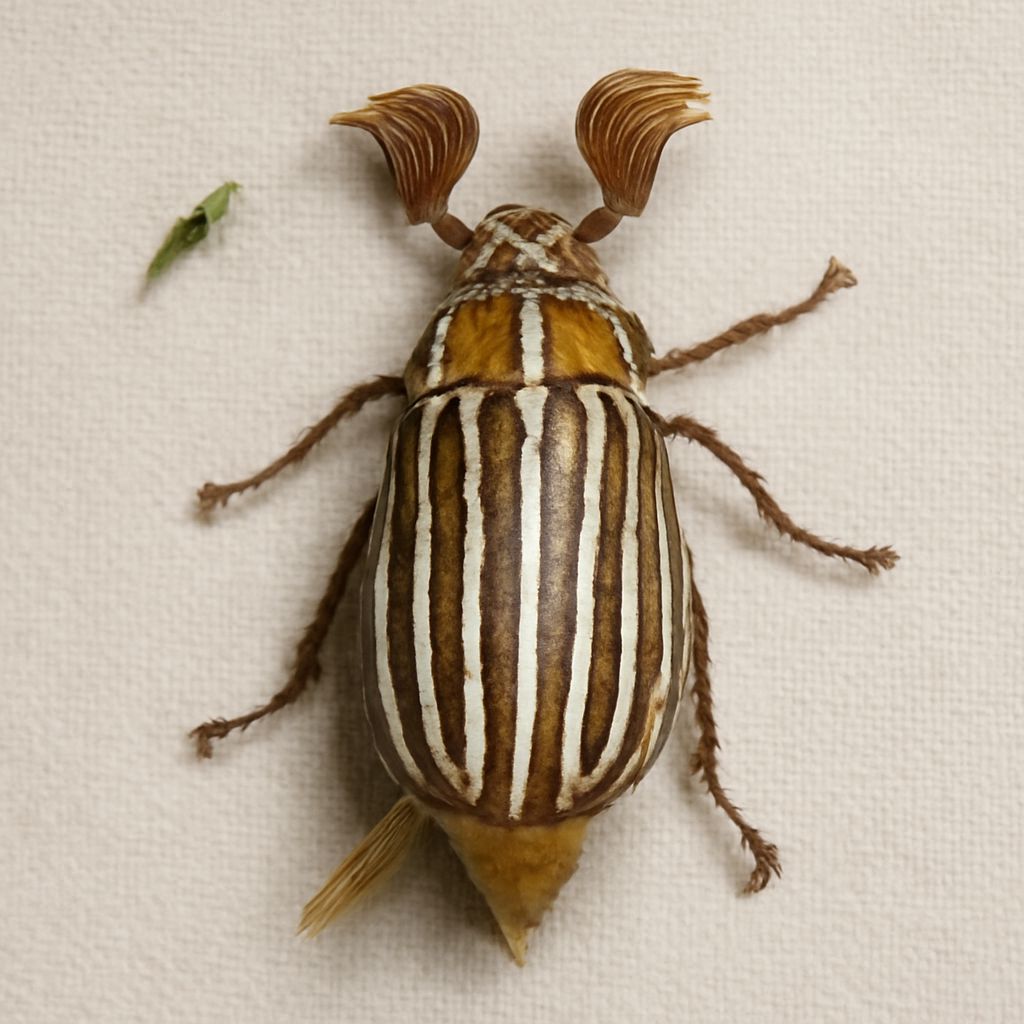
The ten-lined June beetle, Polyphylla decemlineata, is a stout, oval scarab with a dark brown body and pale lengthwise markings on its hardened wing covers. In strong light it is often better described as a brown and white striped beetle than a black one. Adults are roughly an inch long, though individuals vary.
Look at the antennae as well as the stripes. Their tips open into a fan of plates, especially conspicuous in males. The beetle’s rounded back and sturdy legs add to the scarab shape. For a beetle with black-and-white stripes, a photograph from above can show the pattern, while a side view reveals its build. If it opens its wings, the hard outer covers lift to expose the flight wings beneath.
Another Polyphylla can look much the same. Colorado State University describes P. diffracta as a related western Colorado species whose wing-cover stripes are generally more diffuse and less consistently distinct. Compare the whole pattern and location with a regional guide, rather than assigning a name from one pale line. The university’s identification sheet illustrates these differences.
A black and white striped beetle could also belong to a different group entirely. Check whether its body is broad and rounded or slender, whether the markings run along the wing covers, and whether the antennae form a fan. Lighting, wear, and the angle of a phone camera can all change the apparent color.
Can it bite, and why does it hiss?
Can a ten lined June beetle bite? A bite from a ten-lined June beetle is not a typical response to a passerby; it has chewing mouthparts but does not seek people out to bite. Avoid squeezing or holding it: an unfamiliar beetle may pinch or scratch, and a photograph is usually enough for identification. If contact leaves a wound, wash it with soap and water; seek medical care for a serious reaction, a significant wound, or symptoms that worsen.
When disturbed, the beetle can make a wheezy hiss. Colorado State’s account describes air being expelled through spiracles, the openings used in insect respiration. A hissing beetle is giving you a reason to step back, not a reason to pick it up for a second performance. Other insects make defensive sounds too, so a beetle that hisses is not automatically this particular species.
You may also hear the nickname watermelon bug, or watermelon beetle, referring to the striped appearance. Common names travel and overlap: a bug called a watermelon beetle still needs its body shape, markings, and location checked before you give it a scientific name. The nickname does not mean it lives on watermelon plants.
A long life below the surface
The adult is only one stage of a much longer story. Females lay eggs in soil; the larvae hatch into pale, curved white grubs with brown heads and strong mouthparts. They live underground, feeding on roots as they grow. After developing, the larva pupates in the soil and eventually emerges as an adult.
Development can take several years, depending on conditions. In Pacific Northwest orchards, Washington State University describes larvae feeding on the roots of fruit trees, including apple and cherry. The WSU tree-fruit guide explains that this root feeding can damage trees, especially where infestations are concentrated. A grub found in soil is not automatically this species: many scarab larvae are pale and curled.
Adults feed on the foliage of various trees and shrubs and are more visible in warm months. Washington State University notes that males commonly fly in the evening; lights can bring beetles close enough for an unexpected porch encounter. The University of California’s orchard guidance describes adults in tree canopies and among debris during the day. Their feeding and the root-feeding larvae have different effects, so a single adult near a lamp is not enough to diagnose an orchard problem.
Location helps narrow the answer
P. decemlineata is documented in western North America, including the Pacific Northwest and parts of the interior West. A striped scarab encountered on a Panama trip deserves comparison with local species, not an automatic identification from a North American article. Photograph its back, head, and antennae; record the location and date; and share the images with a local naturalist or entomologist.
If the beetle is inside or on a busy path, guide it into a cup using a piece of stiff paper, carry it outside, and release it onto vegetation away from foot traffic. Keep your fingers clear and let it leave the container on its own.