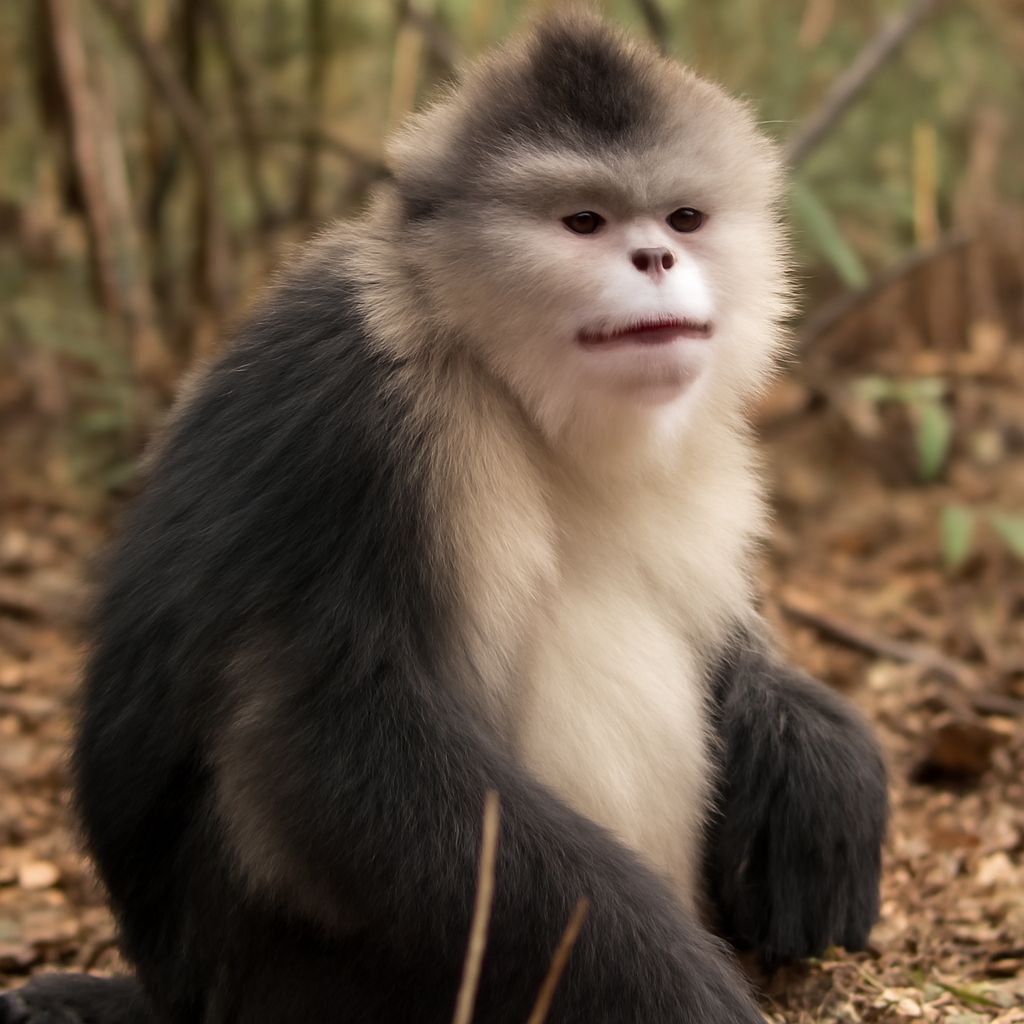
A golden monkey photographed in a snowy Chinese forest and a dark-coated monkey seen in northern Vietnam may share an upturned nose, but they are not necessarily the same species. The short-nosed monkeys of Asia belong to Rhinopithecus, a group whose members live in different forests and face different conservation pressures.
Snub-nosed monkey species and their forest homes
A snub-nosed monkey has a short, flattened nose with nostrils that turn upward. The nose is present, even though the profile can look unusually flat in a photograph. Their coats, facial colors, and ranges vary: the golden species has a warm orange-gold coat and a pale blue face, while other members of the genus can look quite different.
The golden or chinese snub nosed monkey, Rhinopithecus roxellana, lives in mountain forests of central and southwestern China. Its forest home includes mixed broadleaf and conifer woodland, where winters can bring snow. The IUCN assessment lists it as endangered; that assessment was last conducted in 2015 and published in an amended version in 2021.
A 2023 research review recognizes five species in the genus. They are Asian primates, not wild Panamanian monkeys. A mountain-forest setting may be familiar to a visitor to Panama, but location is essential when identifying the animal in a photograph.
How the species differ
The other members of the group show why one common name is not enough to describe every forest or face:
- Yunnan or black-and-white, R. bieti: A dark and pale-coated species of southwestern China’s high forests, where lichens are an important food.
- Gray, R. brelichi: A Chinese species associated with the forests of Guizhou, with a different coat pattern from its golden relative.
- Tonkin, R. avunculus: A northern Vietnamese species with a pale blue facial area, prominent lips, and an upturned nose. Fauna & Flora describes the small, fragmented populations and threats to their forests.
- Myanmar, R. strykeri: A largely dark-coated species found in northeastern Myanmar and adjoining China, with pale facial features and a long tail.
These are broad comparisons. Light, age, sex, and the angle of a photograph affect appearance, while a regional field guide or specialist can use more detailed traits and location to assess an identification. The animals’ ranges are not interchangeable simply because they are close relatives.
The face behind the nickname
The phrase noseless monkey is misleading: these monkeys have noses, but the nasal bones and soft tissues create a short, upturned profile. The visible nostrils are part of that shape. Their faces may draw attention first, but their thick coats, long tails, and forest habits are just as important to understanding the animal.
A short nose is sometimes presented as a proven adaptation to cold. The group occupies more than one kind of Asian forest, and the evolutionary reason for this particular shape is not established by its appearance alone. Describe what you can see and keep a proposed explanation separate from an observed feature.
A menu that changes with the season
Golden monkeys spend much of their time in trees. According to the University of Michigan’s Animal Diversity Web, their food changes through the year: leaves, needles, buds, and other plant material are available in warmer periods, while bark and lichens become important in winter. They can also descend to feed on plants on the ground.
The details differ across species and sites. In high forests where leaves are scarce during colder months, lichens can be an important resource; protecting a forest means retaining the trees and ecological conditions that support those foods. A photograph of a monkey holding a branch shows a moment in a much longer seasonal search for food.
Family units within larger bands
The social lives of snub nosed monkeys can be busy. Small units typically include an adult male, several females, and young; units can associate in larger groups or bands. Animal Diversity Web’s genus account describes this layered social organization across the group. Group size and movement vary with the species and local conditions.
For golden monkeys, reproduction is seasonal. After a gestation of roughly seven months, a female usually gives birth to one infant. Mothers provide much of the care, and other group members may interact with young. An infant’s survival depends on more than the birth itself: it needs prolonged care in a forest that continues to supply food and shelter.
Protecting forests and connected groups
The short-nosed monkey group is threatened by habitat loss, fragmentation, and hunting, though the pressures and their intensity differ by species. When a road or cleared area divides a forest, groups can become more isolated and have less access to food or potential mates. Protecting habitat therefore involves both the forest patches and the connections between them.
In northern Vietnam, Fauna & Flora works with local communities and authorities on monitoring and habitat protection for the Tonkin species. Its project account reports a 2025 estimate of around 160 animals at Khau Ca, a key stronghold. That local estimate is a snapshot of one population, not a count for the whole genus. Continued protection and monitoring help conservation teams understand whether that forest can support the animals over time.