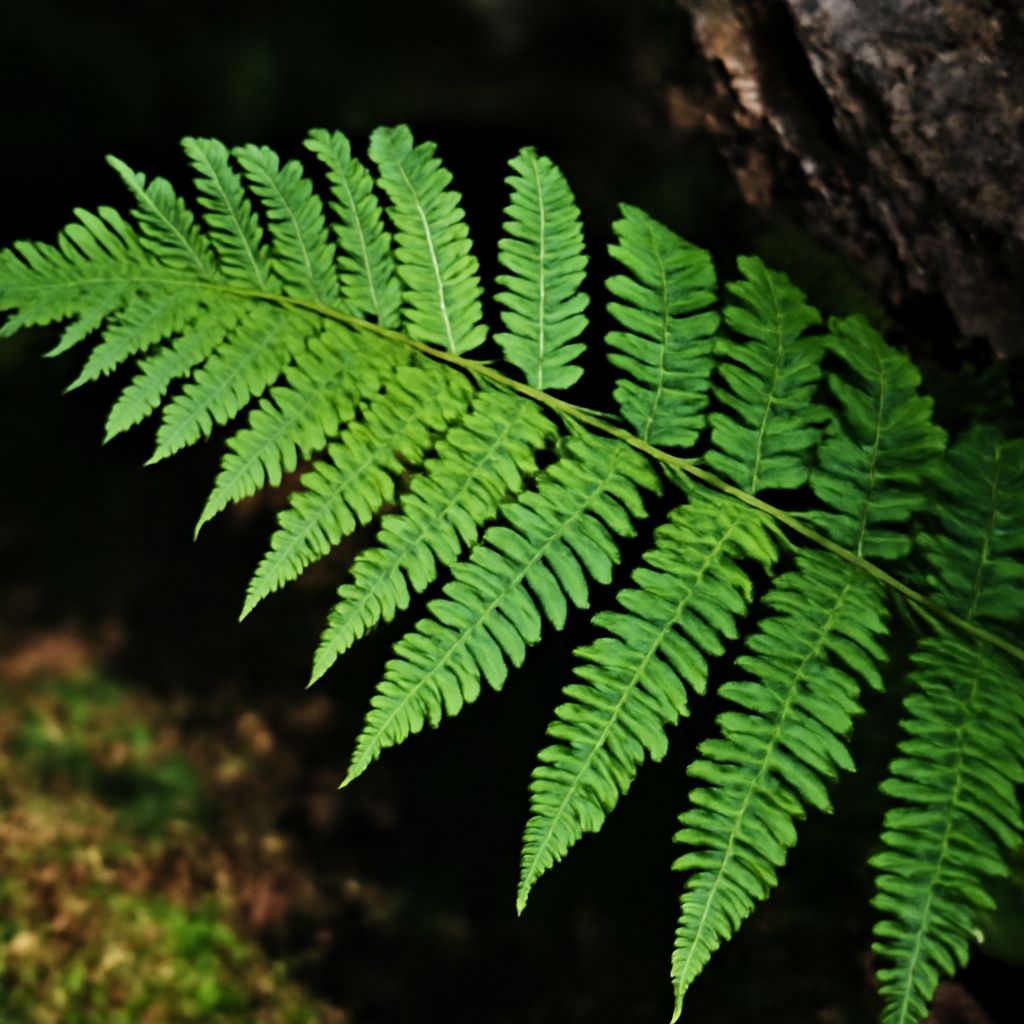
Once you know what ferns are and how their parts work, a green patch beside a mountain trail becomes much more interesting: you can spot a new leaf unrolling, look for spore cases beneath an older one, and follow the plant’s growth along the ground. A little familiarity with the anatomy of a fern turns those details into a story you can read as you walk.
To understand what ferns are, start with their transport system. Ferns are vascular plants: they have tissues that move water and nutrients through their bodies. They have roots, stems, and leaves, but reproduce through spores rather than seeds. Many thrive in humid, shaded places, including cloud forests, while others grow on rocks, in sunnier openings, or even in water. Their range of shapes is a good reminder to look beyond the familiar feathery houseplant.
Fern Anatomy: The Parts You Can See
Start with a frond, the fern’s leaf. Its broad surface captures light for photosynthesis, helping the plant make sugars. In many species the blade is divided into smaller sections, giving it that lacy appearance, but some fronds are simple and strap-shaped. The stalk connects the blade to the rest of the plant. A young frond often emerges tightly coiled; as it grows, it gradually unfurls like the scroll at the end of a violin.
The stem is frequently less obvious. A rhizome may creep across or just under the soil, sending out roots and fronds as it grows. In some tree ferns the stem rises upright, lifting a crown of leaves above the forest floor. Roots anchor the plant and take up water and minerals. Together, these parts explain much of fern anatomy: the fronds gather light, while the rhizome supports growth and connects the leaves with the roots.
A closer look at the anatomy of a fern also reveals the structures involved in reproduction. Turn your attention to the underside of a mature frond and you may see rows or clusters of brown dots. These are often sori, groups of tiny spore cases called sporangia. Their position and shape vary among species; some ferns bear their spore cases on specialized fertile fronds. On a walk, look closely without pulling or turning over delicate leaves.
A Life Cycle in Two Forms
What are ferns doing when those brown dots appear? The familiar leafy plant is the spore-producing stage, called the sporophyte. Inside its sporangia, spores develop and eventually disperse, often on the wind. A spore is a single reproductive cell, so it is much smaller and simpler than a seed containing an embryo and a food supply.
When a spore lands in a suitable moist place, it can grow into a tiny, separate plant called a gametophyte. It usually looks quite different from the leafy fern: many are small, green, and roughly heart-shaped. This stage produces eggs and sperm. Water allows the sperm to swim to an egg; after fertilization, the resulting young sporophyte grows from the gametophyte and develops its own roots and fronds. The Smithsonian’s fern life-cycle guide illustrates these two forms.
This alternation of generations includes a spore-producing stage and a sexual stage. The distinction helps explain what ferns are in a fuller sense: the big leafy plant you notice is only one part of the cycle. Ferns can also spread vegetatively when a rhizome grows and branches, or when a piece becomes established separately. That kind of asexual growth is different from fertilization between sperm and egg, even though both can help a fern persist in a suitable place.
How Much Variety Is There?
How many species of ferns are there? A reasonable broad estimate is around 10,000 species worldwide, as described in the Smithsonian’s fern biodiversity transcript. Treat that as an approximate figure, not a permanent census. Researchers revise names and relationships as evidence improves, and a count depends on the classification and date of the source: one treatment may recognize a group as a species while another combines it with a related one.
If you wonder how many fern species there are in a particular forest, the global estimate will not answer that local question. Elevation, moisture, habitat, and the area surveyed all affect what a local inventory records. A wet ravine, a tree trunk, and an exposed roadside bank can offer quite different living conditions within a short walk.
Diversity is visible in size and form. Some ferns grow close to the ground; others form tall, trunk-like stems. Some perch on trees as epiphytes, using the tree for support, while others root in soil or live in water. Leaves can be finely divided or undivided, and their fertile structures can be arranged in different patterns. These variations show what ferns are capable of across habitats, without requiring you to put a name to every plant you pass.
Looking Closely on a Mountain Walk
In the mountains around Santa Fe, a damp trail can invite a slower pace. Look for the contrast between pale new growth and older, darker fronds. Notice whether the leaves arise from a creeping stem or from a raised crown, and whether nearby plants are growing on soil, rock, or a tree. A photograph of the whole plant and another of a fertile frond can preserve details for later identification while leaving the plant in place.
Rain and mist make the sexual stage easier to understand: sperm need a film of water to reach an egg. Yet a wet-looking patch alone does not reveal which stage is present. The gametophyte is easy to miss among mosses and other small plants, so use a hand lens if you have one and keep your feet on the trail. Mud has a remarkable talent for making its own decisions about where your shoes go.
Knowing what ferns are also changes how you approach the tempting curls of young growth. Some species are eaten in certain places, but a fiddlehead shape does not establish that a fern is edible. Enjoy unfamiliar plants with your eyes or camera, and leave identification and food choices to reliable local expertise.
Quick Field Reminder
- Frond: a leaf that gathers light; some fronds also carry spore cases.
- Rhizome: a stem that supports new growth and may creep along or beneath the ground.
- Roots: structures that anchor the plant and absorb water and minerals.
- Sori: clusters of sporangia, often visible beneath a fertile frond.
- Spores: reproductive cells that can grow into the small gametophyte, beginning the next part of the cycle.