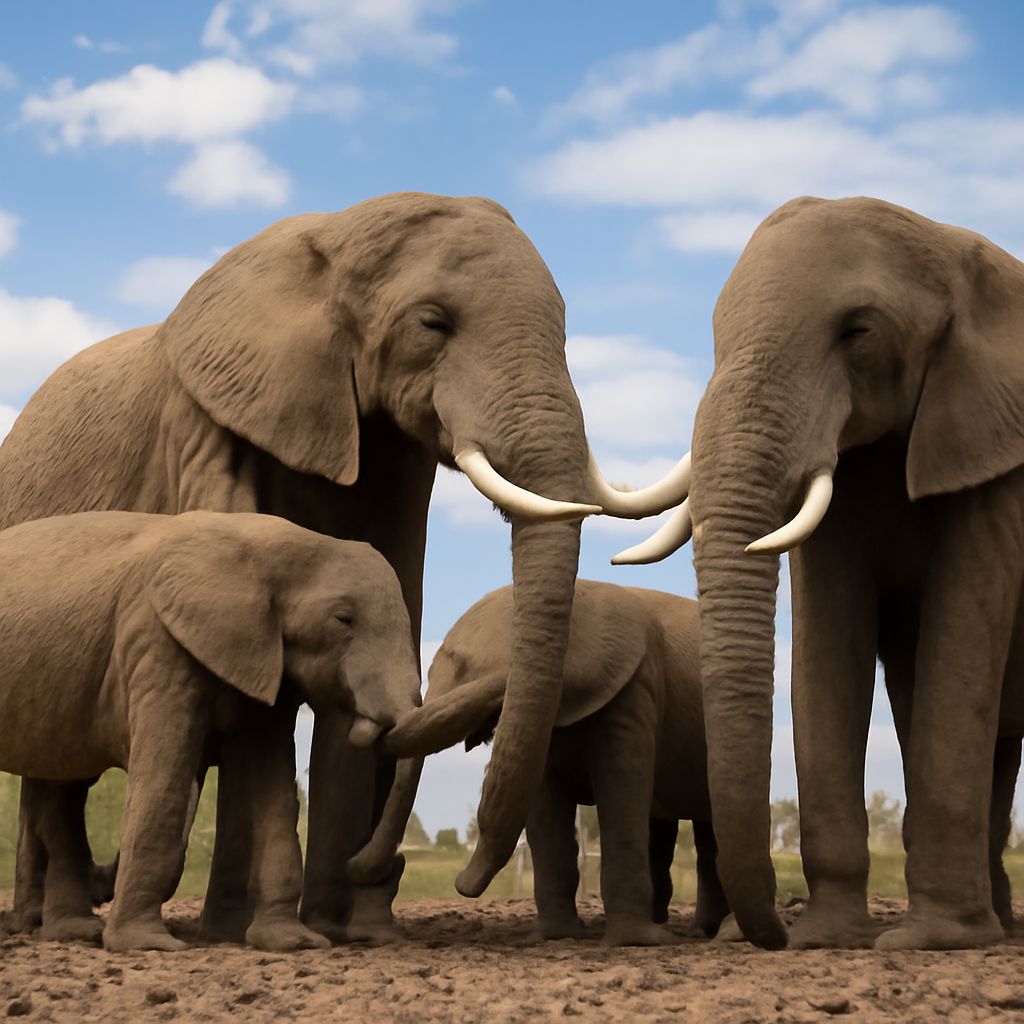
Current IUCN treatment recognizes three living elephant species: African savanna, African forest, and Asian elephant. Those elephant types differ in habitat, body size, and features such as ears and tusks. The distinction is useful when a broad name such as “African elephant” could mean either of two animals.
Different types of elephants at a glance
The IUCN identifies three living species. The two African species belong to the genus Loxodonta; the Asian elephant belongs to Elephas. A genus is a grouping of related species, one level broader than the species name.
| Species | Scientific name | Typical habitat and range | Useful visible clues |
|---|---|---|---|
| African savanna | Loxodonta africana | Savannas, grasslands, and other habitats in sub-Saharan Africa | Largest of the three; large ears and outward-curving tusks |
| African forest | Loxodonta cyclotis | Rainforests of West and Central Africa | Smaller than savanna elephants; rounder ears and straighter, downward-pointing tusks |
| Asian | Elephas maximus | Forests and grasslands in South and Southeast Asia | Smaller ears than African elephants; one fingerlike projection at the trunk tip |
The different types of elephants share a trunk, large body, and social lives, but the details help you distinguish them. Treat the clues as a set: an animal’s age, sex, angle, and surroundings can make a single feature difficult to judge.
Why some sources say two
Ask “how many species of elephants are there” in an older reference and you may find one African species and one Asian species. The African forest and savanna forms were long grouped together. The IUCN’s 2024 African forest elephant status report explains that its Species Survival Commission now recognizes the two African animals as distinct species.
That change is a taxonomic decision: it concerns how scientists classify populations, not a sudden change in the animals themselves. Research on genetics and other evidence helped support the separation and changed the count of elephant species. When comparing books or conservation reports, look at the date and whether “African elephant” means one combined category or the two species separately.
This also explains why the number of living elephant species in a guide may differ from the current count. The three names in the table give you a clear framework for reading current conservation material without treating an older chart as a description of a fourth animal.
The African savanna elephant
The savanna elephant is the largest living land animal. Its ears are broad, and its tusks tend to curve outward. Both males and females generally have tusks, although an individual animal’s tusks can vary. The ears are more than a recognizable outline: their large surface helps release body heat.
Despite the name, this species is not restricted to open grassland. WWF describes savanna elephants in open and wooded savannas as well as some forests and deserts. They occur across parts of sub-Saharan Africa, including areas in eastern and southern Africa. A savanna elehant uses its trunk to gather vegetation and bring it to its mouth.
In an open landscape, the broad ears and curved tusks may be visible at a distance. They are useful hints, not measuring instruments: a young animal can look small beside an adult, and a partially hidden ear can change the apparent outline.
The African forest elephant
The forest elephant generally has a smaller body, rounder ears, and straighter tusks that point downward. WWF’s forest elephant profile places it in the dense rainforests of West and Central Africa. A glimpse through foliage may reveal only an ear or the side of a head, so body size alone is a difficult way to make an identification.
Forest elephants feed on a variety of plants and fruit. By moving through the forest and dispersing seeds, they affect the habitat around them. Their home is not merely a backdrop: thick vegetation can conceal a group that would be easy to see on an open plain.
The two African species have two fingerlike projections at the end of the trunk, according to the International Elephant Foundation. Those projections help with grasping. They distinguish both African species from the Asian elephant, but they do not distinguish the two African species from each other.
The Asian elephant
Asian elephants live in parts of South and Southeast Asia, in habitats that include forests and grasslands. They usually have smaller ears than African elephants and a rounded back. At the trunk tip, one fingerlike projection works with the lower edge of the trunk to grasp objects.
Tusks need careful reading here. Only some male Asian elephants have prominent tusks; females generally lack prominent external tusks. A tuskless animal is therefore not necessarily a young elephant, and tusks alone cannot identify its species. Smithsonian’s National Zoo compares these features with those of African elephants.
You may also hear names such as Sri Lankan or Sumatran elephant. These describe populations or subspecies within the Asian species, rather than separate living species in the count above. Subspecies are named groupings within a species; their treatment can differ among references. A place name tells you something about origin, but it should not automatically add another species to the list.
Which clue should you use?
If you are comparing kinds of elephants in a photograph, begin with the location, then look at the ears, tusks, and trunk tip together. Habitat is a clue rather than a hard border: savanna elephants can also use forests, and an animal’s position may hide the feature you want to see.
For an unfamiliar animal, use the combination of range and several visible traits, and keep the identification tentative if the picture shows too little.